VILLALCÁZAR DE SIRGA

Audios

CHURCH OF SANTA MARÍA LA BLANCA

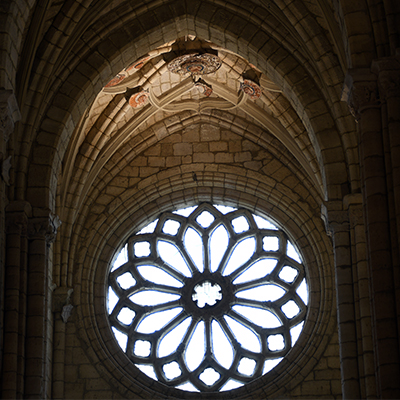
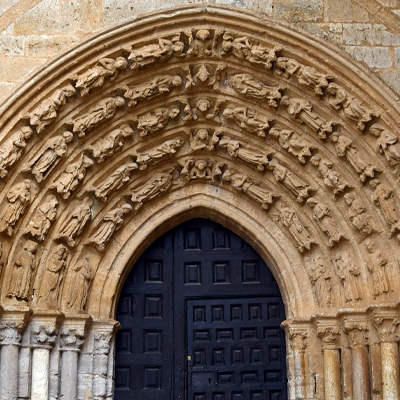
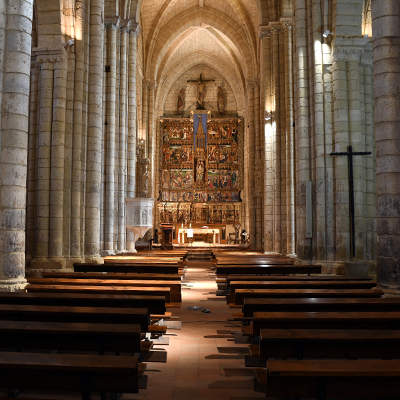
The church of Santa María La Blanca (Saint Mary the White) in Villalcázar de Sirga is one of the most impressive medieval churches on the Camino de Santiago. Construction on it began at the end of the 12th century on the initiative of the Knights Templar, a powerful military and religious order responsible for protecting pilgrims. The church is an excellent example of late Romanesque architecture anticipating the new Gothic forms arriving from France. The initial project was so ambitious that it was never fully completed. Originally, the church had a monumental door on its western side, the so-called Angel Door, but it disappeared as a result of the devastating Lisbon earthquake of 1755. Today, the main entrance is through the imposing south façade, sheltered under a grandiose portico that is as high as the central nave. There, two portals richly decorated with Gothic sculptures await us. Angels, saints, clergymen and musicians join in a procession of stone, welcoming those who cross the threshold. Above the door, two friezes narrate scenes from the Epiphany and the Annunciation, together with representations of the Apocalypse and the return of Christ in Majesty. These reliefs are undeniably influenced by the Romanesque churches of Carrión de los Condes. Once inside, we are surprised by a grandiose space with three naves separated by cruciform pillars. These pillars support pointed arches and elegant ribbed vaults, typical of the Gothic style. The sensation of verticality and solidity is impressive, reflecting the monumental nature of Templar architecture. In the Middle Ages, this church achieved great fame. So much so that the King of Castile himself, Alfonso X, known as “the Wise”, visited the temple to do penance before the image of the White Virgin. His devotion was so deep that he even dedicated to her some of his famous narrative songs known as the Cantigas de Santa María, composed at the end of the 13th century. One of them, number 278, tells of the miraculous healing of two blind pilgrims, one of them a French woman: ‘This is the tale of a beautiful miracle that Emmanuel’s mother showed in Villasirga, where she often performs many others sweeter tan honey…’

ALTARPIECE

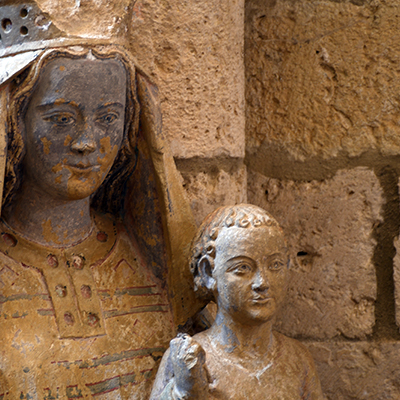
The altarpiece in the church of Santa María de Villalcázar de Sirga is a real gem of religious art, a masterpiece that combines pieces from different periods and styles. What we see today is the result of restoration work carried out between 1945 and 1946. During this work, the original panels were rearranged, openwork cresting was added, as well as the canopy framing the image of the Virgin and the heraldic shields, giving the whole an appearance similar to 15th-century Hispano-Flemish altarpieces. However, the most important part of the altarpiece does actually belong to that period. We are talking about the twenty-seven panels attributed to Maestro Alejo, a local artist who some relate to Pedro Berruguete, the great painter of the transition from Gothic to Renaissance. These paintings depict saints, scenes from their lives and passages from the Gospel, organised in three vertical sections, four panels, two panel joints and a plinth at the base. In the 16th century, a second predella or supporting plinth was added, this time in Renaissance style. This part of the altarpiece is the work of the sculptor Manuel Álvarez, with exquisite polychrome work by Francisco de Carracejas. The oldest elements of the altarpiece are the Virgin and Child, a 13th-century Gothic image that occupies the centre of the altarpiece, the space of honour; and the Calvary located at the top. This comprises three carvings, also Gothic, dating from around the year 1300: the crucified Christ, Saint Mary and Saint John. The altarpiece of Santa María de Villalcázar de Sirga is, in short, an exceptional testimony to the way art has evolved over the centuries. It is a work that masterfully combines Gothic, Renaissance and modern interventions, and which continues to dazzle those who contemplate it.

TOMBS

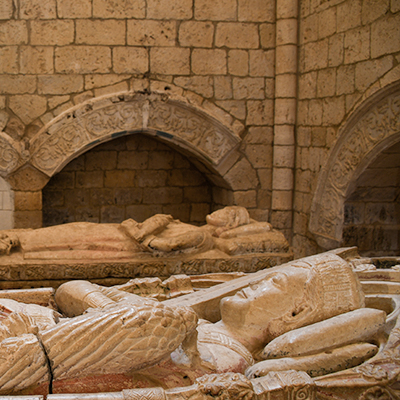
The church of Santa María de Villalcázar de Sirga is home to the chapel of Saint James, a space steeped in history and symbolism. Built in the 14th century, this chapel is illuminated by a beautiful rose window and is covered by a ribbed vault decorated with the coats of arms of the Order of Santiago. This military order assumed much of the control of Villalcázar after the dissolution of the Templars, who had dominated the town during the Middle Ages. The most outstanding feature of this chapel is the three Gothic tombs it houses. Two of them belong to the Infante Philip of Castile and his second wife, possibly Inés de Guevara. The third is the tomb of the knight Juan de Pereira, a member of the Order of Santiago. The tombs of Philip and Inés de Guevara are true masterpieces of Spanish medieval sculpture. They are carved in polychrome stone and have an exceptional degree of detail. The infante, or prince, Philip, born in 1231, was the son of King Ferdinand III and Beatrice of Swabia. His life was marked by conflicts with his older brother, Alfonso X the Wise. Although he began his ecclesiastical training in Paris, he abandoned it to marry Princess Christina of Norway. He later married twice more. He died in 1274 and was buried in this church alongside his second wife. His tomb is particularly innovative for its time. On the four sides of the sarcophagus, his own funeral procession is narrated in a sequence that begins with an image of him on his deathbed and concludes with prayers for his soul. The lid is surrounded by coats of arms, both his and those of the Knights Templar, and the recumbent statue depicts him wearing a royal cap, tunic and heraldic cloak. The tomb of Doña Inés is a little smaller and has a similar design, though it has no decoration on the shorter sides. Her recumbent figure is shown wearing a high tiara with a chinstrap covering her mouth and a tunic adorned with her family’s coats of arms. Originally, these tombs were located in the choir area, but in 1926 they were moved to the chapel of Saint James. Some of the fabrics and ornaments that covered the bodies of the deceased are still preserved in the National Archaeological Museum in Madrid and in other museums in different countries. This chapel also houses the beautiful Gothic image of the White Virgin. Numerous miracles are attributed to this 13th-century carving, some of which are recorded in the spiritual songs known as Cantigas, written by King Alfonso X the Wise. The chapel of Saint James is, without doubt, a fascinating corner of this church, where art, history and spirituality merge to offer us a unique testimony of the medieval period.

3D Tour

Photo Gallery

VILLALCAZAR-1
VILLALCAZAR-2
VILLALCAZAR-3
VILLALCAZAR-4
VILLALCAZAR-5
VILLALCAZAR-6

Location