The church of Saint Martin of Tours stands right on the Camino de Santiago and is one of the finest examples of European Romanesque architecture. Its history began in the 11th century, when it formed part of a monastery founded by Doña Mayor, Countess of Castile and Queen of Navarre. Although the monastery disappeared, the church is still standing as a testament to spirituality and medieval art.
Its artistic importance was recognised from very early on, as in 1894 it was declared a National Monument, a recognition accorded to few buildings until then. However, at the end of the 19th century, it was in an alarming state of repair, so much so that it was feared it might collapse. To avoid this, ambitious restoration work was undertaken, with the most dilapidated parts being dismantled and rebuilt. In addition, elements added over the centuries, such as porticoes, the sacristy and the organ, were removed with the aim of restoring it to its purely Romanesque appearance. The church was reopened on 11 November 1911.
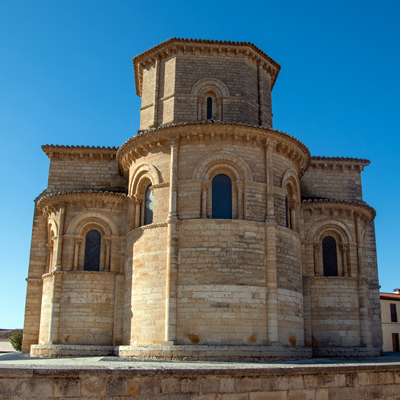
The exterior of the building is harmonious and balanced. Particularly striking are its octagonal lantern tower, the three semi-circular apses and, above all, the two cylindrical turrets on the main façade, which have become its emblem. In the tower on the left, a metal rooster keeps watch from above; the one that crowned the right tower disappeared after being struck by lightning.
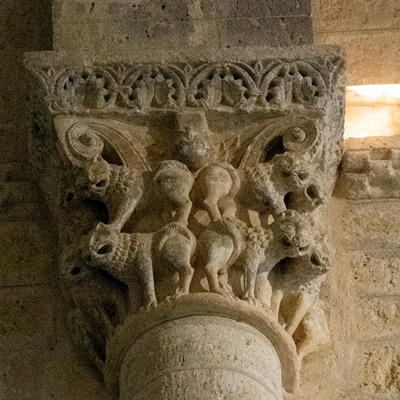
If we look closely, we can see that the whole building is decorated with a frieze with a chequered pattern, a geometric motif very characteristic of Romanesque art, which runs along the walls like an ornamental belt. And under the roof eaves there are more than 300 stone corbels representing a veritable gallery of figures of animals, human beings and a variety of fantastic creatures.
The interior is a pure, sober and perfectly proportioned space where light and stone create an atmosphere of peaceful retreat. It has a three nave structure covered by barrel vaults and in the centre there is an impressive hemispherical dome over the transept.