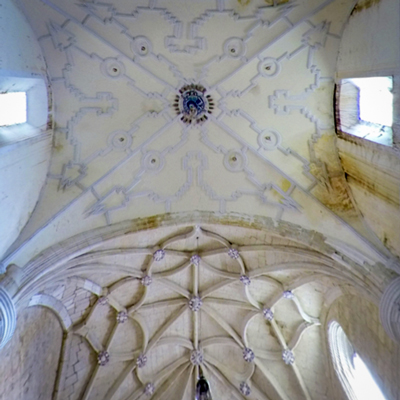
Construction on the church of Santa María de la Asunción (Saint Mary of the Assumption) began in the 16th century on the remains of an old Romanesque temple. However, the building process was long and drawn-out, lasting almost two centuries. Not until 1770 were its vaults completed, finally providing a roof for the church.
Despite the changes and extensions, there are still vestiges of its Romanesque past, such as some remains visible at the base of the tower. But without a doubt, the most valuable testimony of this period is its 13th-century baptismal font. Beautifully carved, it is decorated with circles, rosettes, fleurs-de-lis and interlaced arches, characteristic elements of medieval art.
Following the construction tradition, the altar was the first part of the church to be built. This is why the oldest part is the apse or main chapel, which is in the Gothic style with some Renaissance details.
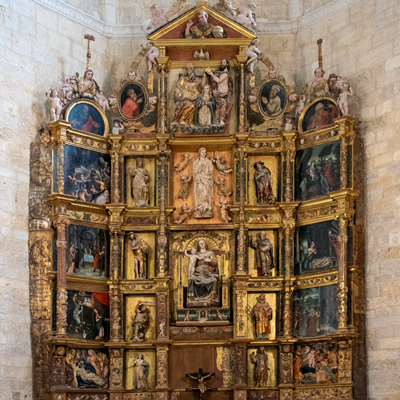
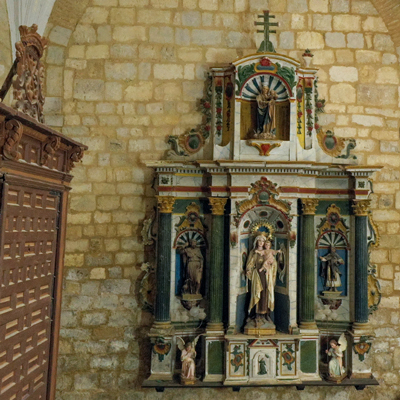
The church has a nave and two side aisles, with a choir, a sacristy and a baptistery, the small chapel used for baptisms. But if there is one work that stands out from the rest, it is the main altarpiece. It was made in 1548 by three distinguished sculptors: Pedro de Flandes, Mateo Lancrín and Jean de Cambrai, who were part of a group of Flemish and Burgundian sculptors who set up their workshops in the city of Palencia in the first half of the 16th century.
The altarpiece is structured on several levels. In the predella, or lower part, we find two high-quality reliefs: the Pietà and the Adoration of the Magi. In the second section, scenes such as the wedding of the Virgin and the birth of Christ are represented, accompanied by figures of saints. Notable features on the third level are the birth of the Virgin and the Adoration of the Shepherds, together with depictions of Saint Gregory, the Assumption and Saint Jerome. Finally, in the attic, the upper part of the altarpiece, there is a relief of the Coronation of the Virgin, rounding off the ensemble with an image of great symbolism.
A curious feature of the church is a Christ figure from the now defunct church of Saint Michael. Tradition has it that when the image was carried in procession, as it passed the site of its former church, the carving became heavier, as though it wanted to stay in its original home.