On the banks of the River Carrión, next to the Camino de Santiago, stands the monastery of San Zoilo, a place steeped in history that, since its origins, has been a significant religious and political centre. Its importance was recognised in 2002, when it was declared a Site of Cultural Interest.
The monastery gets its name from Saint Zoilus, a Christian from Cordoba who, together with other martyrs, lost his life in the year 304 during the persecution of Diocletian, the last great Roman emperor who attempted to eradicate Christianity. In the 11th century, Count Gómez Díaz transferred his relics to the monastery of Saint John the Baptist. With the arrival of the martyr’s remains, it changed its dedication to Saint Zoilus.
The origins of the monastery date back to at least the year 948, but its destiny changed in 1076 when it was donated to the influential Order of Cluny. Under their tutelage, San Zoilo grew in prestige and became a key setting in the history of Castile.
It was here that religious councils were held, in other words, ecclesiastical meetings where decisions about the Church were made; it was also where the “Cortes” met, assemblies in which the kings debated with the nobles, the towns and the clergy. San Zoilo was also the venue for royal weddings and is still the pantheon of the powerful Counts of Carrion. It is not surprising that it was a famous place among pilgrims, not only because of its religious importance, but also because they were allowed to eat bread and wine with no restrictions, as part of its hospitality.
In the 16th century, San Zoilo broke away from Cluny and became part of the powerful Benedictine congregation of San Benito el Real in Valladolid. This change marked the beginning of a new era of splendour, reflected in the construction of one of its great architectural jewels: the cloister.
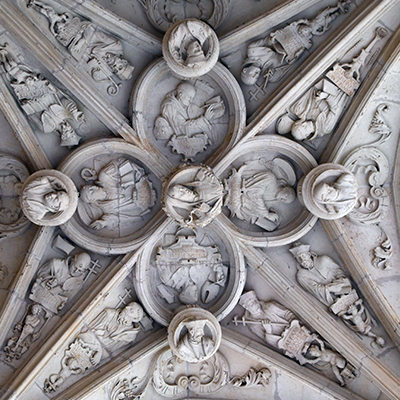
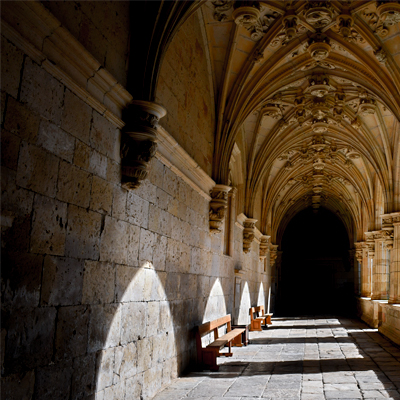
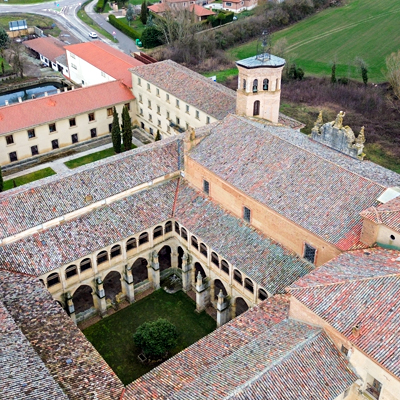
Built in the 16th century, this Renaissance cloister is a masterpiece. It is built on two floors and replaced the previous Romanesque cloister. The most striking features are its 230 medallions, which are carved with portraits of historical and religious figures, and its impressive ribbed vaults, ceilings with a network of elegant criss-crossed stone ribs.
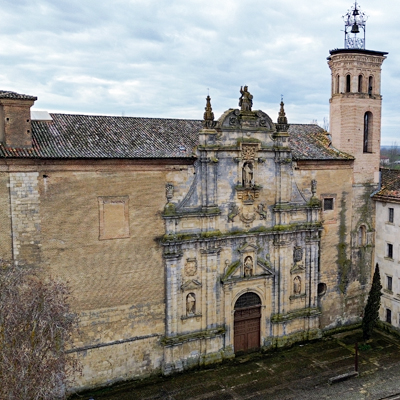
The church we see today dates from the 17th century, although its foundations are much older, as it was built on the site of the original Romanesque church. It is a single-nave church, with a large transept and a lantern tower rising above the centre of the building. Its ceiling consists of barrel vaults, a type of semi-circular roof characteristic of Romanesque art. Inside, the tombs of the Counts of Carrion are preserved, along with two valuable 11th-century Islamic fabrics, known as the ‘Mantle of the Count and Countess’. These pieces are especially rare because they have survived intact to the present day, with their original selvages, the edges of the fabric that prove they have not been cut.
The monastery, like so many others, suffered the consequences of the so-called “desamortización” of the 19th century, when the State confiscated and sold numerous properties belonging to the Church.
The Diocese of Palencia ceded it in 1854 to the Society of Jesus, who took charge of the complex and turned it into a school and, later, into a novitiate, a place of training for future priests of the order. The Jesuits remained here until 1954, when the building became the Diocesan Minor Seminary.
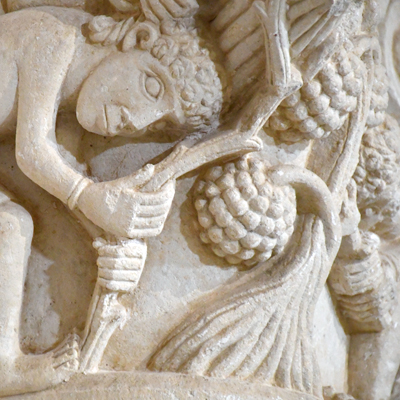
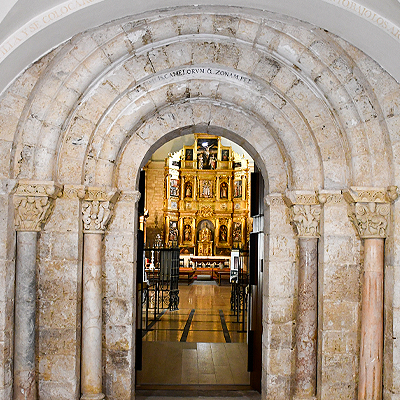
In 1992, the monastery was sold for use as a hotel, but its monumental part remained in the hands of the Diocese of Palencia. Paradoxically, it was during the restoration work in 1993 that an unexpected find was made: after centuries of being hidden, the walled-up Romanesque doorway was discovered. A testimony in stone which, like so many other stories of this place, had been waiting patiently to be rediscovered.